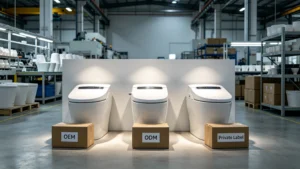
If you’re planning to sell smart toilets under your own brand, you’ll run into three terms very quickly: OEM, ODM, and private label. Suppliers use them constantly, often interchangeably, and rarely explain what changes for you depending on which one you pick.
That’s a problem, because the difference isn’t just terminology. It decides how much you’ll invest upfront, how long your product takes to launch, what you’re allowed to change about the design, and who owns what if the relationship ends.
Here’s what each model actually involves, and how to figure out which one matches where your business is right now.
What OEM Means in Smart Toilet Manufacturing
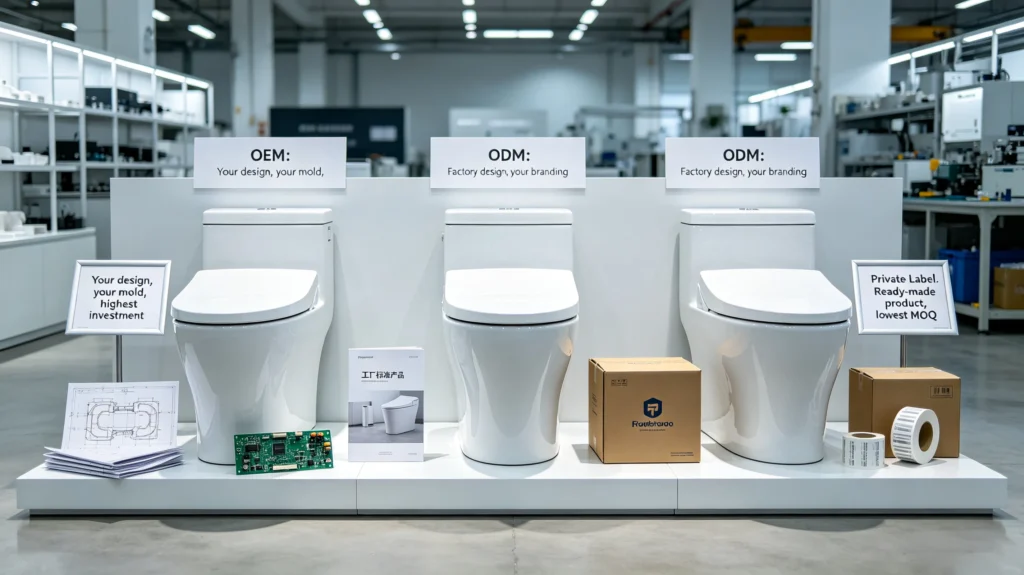
OEM (Original Equipment Manufacturer) means the factory builds a product to your specification. You bring the design — or you work with the factory to refine one — and they manufacture it under your brand.
In practice, for smart toilets, “your specification” usually means:
- You choose (or co-develop) the mold: bowl shape, tank design, overall dimensions
- You specify the electronics package: heating type, spray functions, control panel, remote
- You own or share ownership of the tooling and the design
- Your logo, packaging, and manuals go on the finished product
OEM gives you the most control and the most differentiation, but it also means the longest development cycle and the highest upfront investment, because molds and custom electronics take time and money.
What ODM Means
ODM (Original Design Manufacturer) flips the arrangement. The factory has already designed the product — the mold, the electronics, the whole platform — and they produce it for you with your branding.
With a smart toilet ODM, you’re essentially selecting from the factory’s existing catalog and then customizing around the edges: logo, packaging, color of the seat ring, maybe a feature bundle change if the factory allows it.
The trade-off is straightforward. You launch much faster (often weeks instead of many months), you invest far less upfront, but the product itself isn’t unique. If the design sells well, nothing stops the same factory from building a very similar unit for another buyer.
What Private Label Means
Private label (sometimes called white label) goes one step further than ODM. The product already exists, already has its mold, may even be in production for other brands — and you put your label on it, usually with minimal changes and low minimum order quantities.
For smart toilets, private label typically looks like:
- The factory’s standard model, in their standard packaging structure
- Your brand name and logo on the product and box
- Low or moderate MOQs, because the tooling is already paid for
- Fastest possible time to market
The catch: you have the least differentiation and the least pricing power. Multiple sellers may be offering a nearly identical toilet with different stickers on it.
The Three Models Side by Side
| Comparison | OEM | ODM | Private Label |
|---|---|---|---|
| Design origin | Yours (or co-developed) | Factory’s existing design | Factory’s ready-made product |
| Upfront investment | Highest (tooling, molds) | Moderate | Lowest |
| Time to launch | Longest | Medium | Fastest |
| Product uniqueness | High | Low-medium | Lowest |
| MOQ | Higher | Medium | Lower |
| Customization depth | Full (structure, features, finish) | Surface-level (logo, packaging, bundles) | Branding only |
| Best for | Established brands with volume | Brands wanting a middle path | Testing a market quickly |
Where the Real Cost Differences Come From
The sticker price of a unit is the least interesting part of the comparison. Here’s what actually drives your total cost under each model:
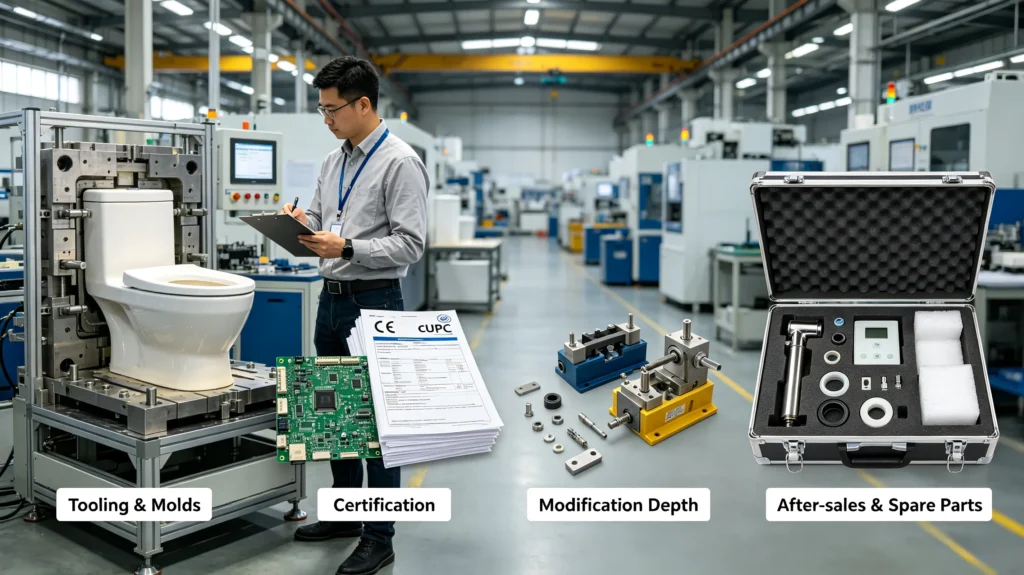
Tooling and molds. A smart toilet mold is a serious investment — the ceramic body, the seat, and the electronic assemblies each have their own tooling. Under OEM, you fund or co-fund this. Under ODM and private label, the factory has already amortized it across their production runs, which is why your MOQ and upfront payment drop.
Certification. If you’re selling into Europe, the US, or Australia, the product needs CE, cUPC, Watermark, or equivalent certifications. An OEM product that you specified may need its own certification path. An ODM or private label model that’s already certified can ride the factory’s existing certificates — but check whether the certificate covers your exact configuration, and whether it lists the factory or your brand.
Modification depth. Every change you request — a different spray module, a reshaped bowl, a new control board — triggers engineering review, sampling, and retesting. This is why OEM lead times are measured in months and why “small” changes on paper can be expensive in reality.
After-sales and spare parts. Whoever owns the design also owns the spare parts supply chain. Under private label, if the factory discontinues the model, your brand’s product is discontinued with it. Under OEM, you control that decision — and the inventory responsibility that comes with it.
Which Model Fits Your Situation
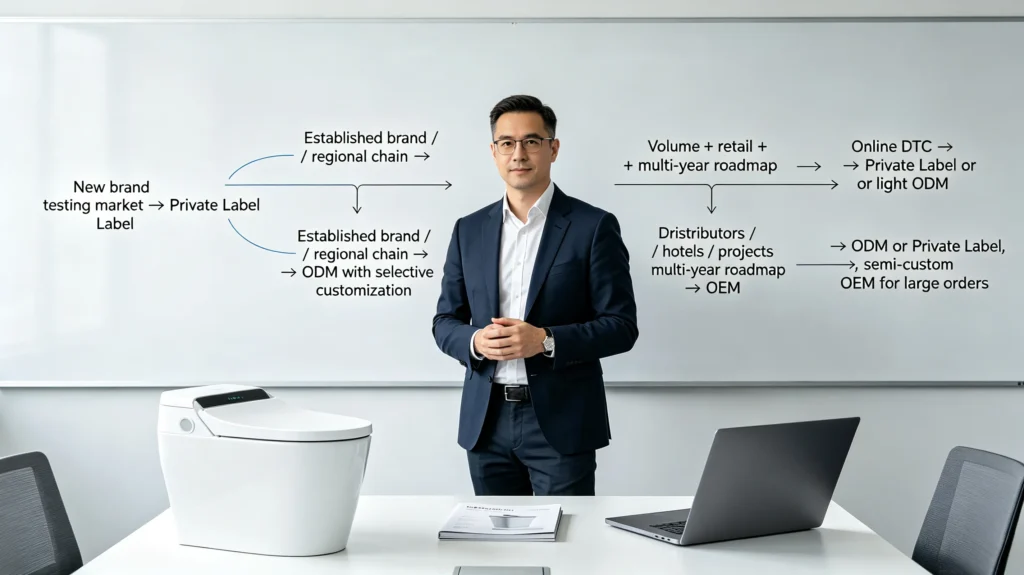
Match the model to your business reality, not to your ambitions:
You’re a new brand testing the market. Private label. Get a proven product into the channel, learn what your customers actually care about, and keep your capital for marketing rather than tooling.
You’re an established brand or regional chain. ODM with selective customization. You get speed to market with enough branding depth (packaging, feature bundles, finish options) to feel distinct.
You have volume, retail presence, and a multi-year roadmap. OEM. The differentiation and margin control only pay off at scale, but at scale they pay off significantly.
You’re a distributor or project buyer (hotels, developments). Usually ODM or private label with your branding for your customer base. If a specific project needs custom configurations, a factory with in-house R&D can quote a semi-custom OEM path for larger orders.
One more angle worth considering: your sales channel. If you sell through distributors who demand exclusivity, OEM gives you a stronger exclusivity story. If you sell direct-to-consumer online, differentiation matters less than speed and margin — which often tilts the math toward ODM or private label.
Questions to Ask Before You Commit
Whichever model you’re leaning toward, these questions expose most of the risk early:
- Who owns the mold, and what happens to it if we stop working together? Get the answer in the contract, not in a WeChat message.
- Is the certification under this exact model and configuration, and in whose name? A CE certificate for “similar product” is not a certificate for your product.
- What is the real MOQ, and what’s the break-glass option if first sales are slow?
- Can you guarantee the same mold and components for repeat orders in 12 months? Factories revise platforms; you need written continuity terms.
- What’s the spare parts commitment — which parts, for how many years, at what price?
- Will you sign an NDA and a non-compete for my market on this design? Meaningful for OEM and customized ODM; less so for pure private label.
A factory that answers these directly and puts them in writing is telling you something important about how the whole partnership will go. Evasive answers on molds and certificates are the single most common source of trouble we see buyers walk into.
Mistakes That Cost Buyers the Most Money
Choosing OEM too early. Paying for tooling before you’ve validated demand with a smaller batch is the classic first-time error. A hybrid path — start with private label, develop your OEM design while the market tests — exists and works.
Choosing private label and competing on brand alone. If three other importers sell the same toilet, price becomes your only lever. Have a differentiation plan (service, bundle, content, channel) before you commit.
Ignoring certification ownership. Especially for the US market, where cUPC listing matters to inspectors and retail buyers alike. Confirm the listing scope before signing anything.
Not planning for continuity. Your best-seller gets discontinued because the factory retired the platform. Negotiate last-buy options and safety stock terms up front.
FAQ
Can I switch from private label to OEM with the same factory later?
Usually yes, and it’s a sensible path: many factories will develop your custom mold once your volumes justify it. Discuss the roadmap before the first order so the factory knows where the relationship is heading.
Which model gets to market fastest?
Private label, typically — a production-ready product with your branding can ship in weeks. ODM follows, and OEM takes the longest because of tooling, sampling, and certification.
Do I need a different MOQ for each model?
Generally, yes. Private label MOQs are lowest because tooling exists; OEM MOQs are highest because the factory needs the run to make sense alongside your tooling investment.
Who handles certification for an ODM product?
Usually the factory holds the certificates, but always verify the certificate covers your exact configuration and ask for copies. For your own OEM design, expect to fund certification as part of the project.
Let Your Sales Channel Decide
If there’s one decision rule to take from all of this, it’s this: start from how you’ll sell, then pick the manufacturing model — not the other way around.
Selling into hotels, developments, or through distribution partners who care about a product story? OEM or customized ODM gives you something to say that competitors can’t copy overnight. Selling online, fast, against a market that mostly buys on features and reviews? Private label or light ODM gets you there while your competitors are still waiting for mold samples.
Wherever you land, the conversation goes better with a factory that runs all three models under one roof — you’re never pushed toward the option that happens to fit the production line. That’s exactly how we structure things at Bikibath, so if you’re weighing a first order or a full OEM program, tell us your channel and volume and we’ll map the realistic path with you.
Learn more about our product range in the Katalog für intelligente Toiletten, or Kontaktieren Sie uns for an OEM/ODM quote.
 English
 Português do Brasil
 Español de México
 Deutsch
 Français