
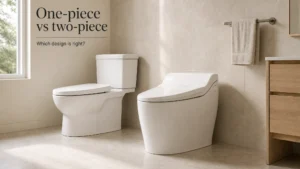
The shape gives it away first. Put a one-piece smart toilet next to a two-piece and even someone who knows nothing about bathrooms will notice the difference. One is a single smooth curve of ceramic. The other still has a tank sitting on the bowl, like every toilet they’ve ever used.
Here’s the annoying part. The spec sheets read almost identical. Warm wash, heated seat, same remote in the box, sometimes the exact same seat module. The prices, though, can be miles apart.
So what is that extra money buying? Is the two-piece just the budget version, or does it earn its place?
It earns it. The two designs solve different problems, and once you see what the structure changes in day-to-day life, most people know which one is theirs within a minute.
What Is a One-Piece Smart Toilet?
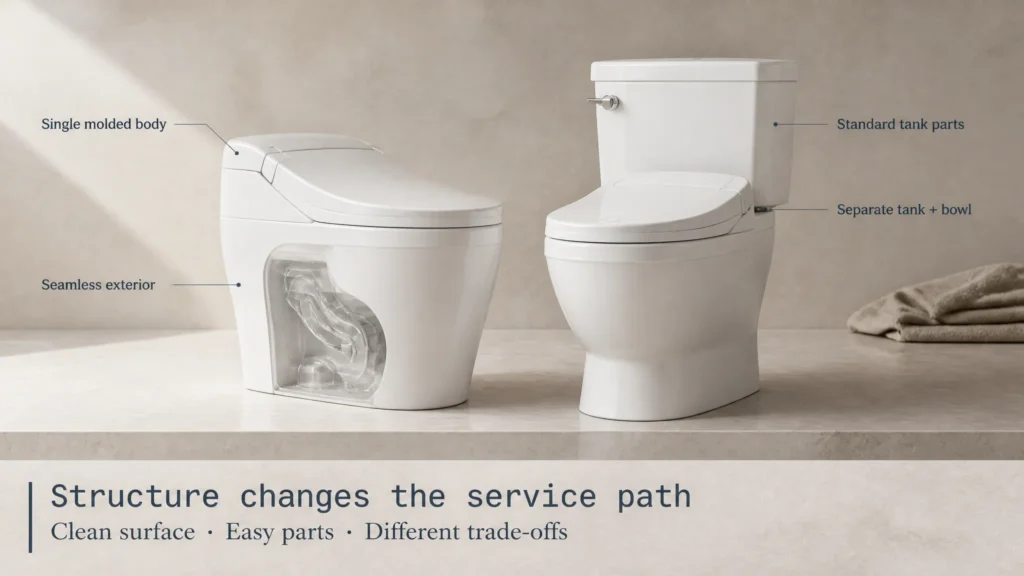
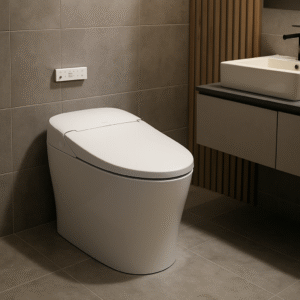
One ceramic body. The tank and the bowl are cast together as a single piece, and the electronics live inside the base and the seat.
Almost everything else follows from that. There’s no joint anywhere, so there’s nowhere for grime to settle, and cleaning the outside is one wipe from lid to floor. Because the tank sits lower and further back, the whole unit reads compact instead of bulky. It’s also the shape people picture when they hear “smart toilet,” which is why it’s all over showroom photos and hotel brochures.
All of that comes at a price, though. Casting one big ceramic body is harder than casting two small ones, and firing a body that size leaves no room for error. A flaw anywhere means scrap.
What Is a Two-Piece Smart Toilet?
A separate tank bolted onto a separate bowl, with the smart seat and controls added on top. In other words, the structure toilets have used for a hundred years.
Don’t mistake that for outdated. The two halves are cheaper to mold and easier to pack, so the price comes in lower. Tank internals like the fill valve and the flapper are commodity parts that cost a few dollars, and any plumber can swap them in ten minutes. When something goes wrong, you fix it on a Tuesday morning and forget about it by lunch. There’s also the practical matter of delivery: two boxes beat one enormous crate when your building has a narrow staircase and a landing that turns at ninety degrees.
You give up the seamless look. That’s the trade, and honestly it’s not a bad one.
One-Piece vs Two-Piece: The Main Differences
| What matters | One-piece | Two-piece |
| Structure | Single molded ceramic body | Separate tank bolted to bowl |
| Look | Seamless, low-profile | Familiar, traditional |
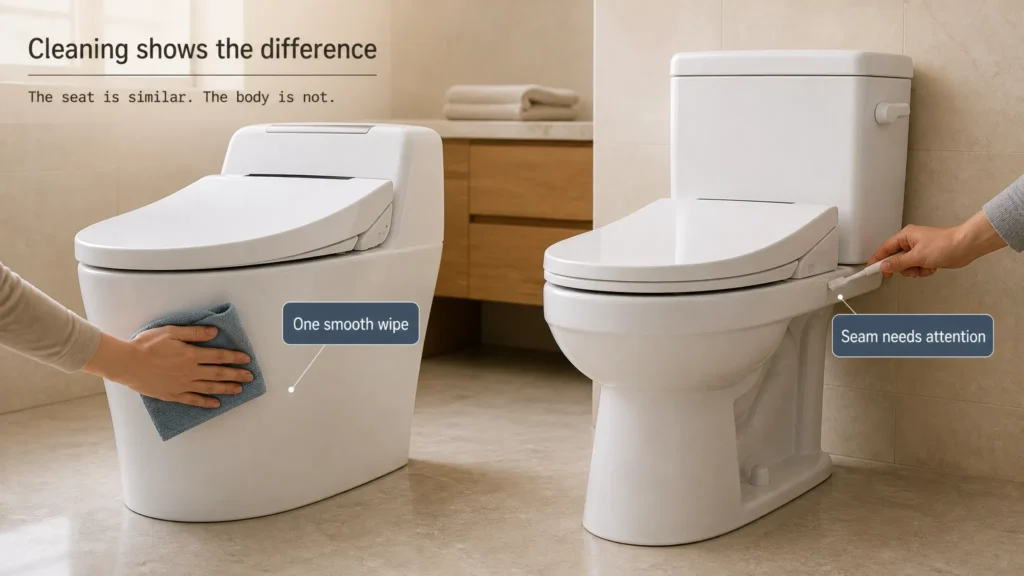
| Cleaning | One smooth surface, no seam | Seam at the tank joint needs attention |
| Upfront cost | Higher | Lower |
| Repairs | Integrated parts, factory service | Standard tank parts, cheap fixes |
| Moving & handling | One heavy, awkward unit | Two manageable pieces |
| Tank-to-bowl leak risk | None (no joint) | Small but real over the years |
| Best for | Renovations, master baths | Budget upgrades, rentals, tricky stairs |
You don’t need to agonize over all eight rows, either. For most buyers, two of them decide everything: how much you hate cleaning that seam, and how you feel about calling a plumber. Everything else is noise.
Why the one-piece costs more
It’s mostly physics, not marketing. A body that big needs a more complex ceramic mold. The firing process is less forgiving, since a single flaw anywhere ruins the entire unit. Packaging has to protect something large and heavy through a long sea voyage, and hiding the plumbing inside the base takes engineering that someone has to pay for.
The two-piece sidesteps all of it. Smaller molds, smaller boxes, more units per container. Part of that saving reaches the sticker price.
Cleaning: Where the Difference Shows Daily
Ask anyone with a two-piece toilet which part of the bathroom they hate cleaning and you’ll usually get the same answer. The seam where the tank meets the bowl. Water and dust work their way into the groove around the bolts, and the only tool that really fits is a cloth wrapped around one finger, or a toothbrush you’ve retired from the kitchen.
A one-piece has no seam, so the job simply doesn’t exist. If you clean your own bathroom, or you run rentals and clean between guests, you’ll feel the difference on day one. And every week after that, frankly.
One honest caveat: the part you clean most often on either design is the smart seat itself, and that part is identical on both. The body underneath is what changes.
Repairs: Where the Two-Piece Fights Back
Every toilet eventually needs a part. On a two-piece, that usually means a fill valve or a flapper. A few dollars at the hardware store, no tools, done. Plumbers have replaced these parts so many times they could do it half asleep.
A one-piece works differently. The components are built into the body, so a failure can mean ordering a specific part from the manufacturer and waiting for it to ship. In the worst case, the unit can’t be repaired economically at all. Reputable manufacturers design around this with modular electronics and long spare-parts commitments. Ask about it before you buy, and pay more attention to the electronics than the ceramic, because the ceramic will outlast everything else in the room.
Installation and Moving: The Overlooked Factor
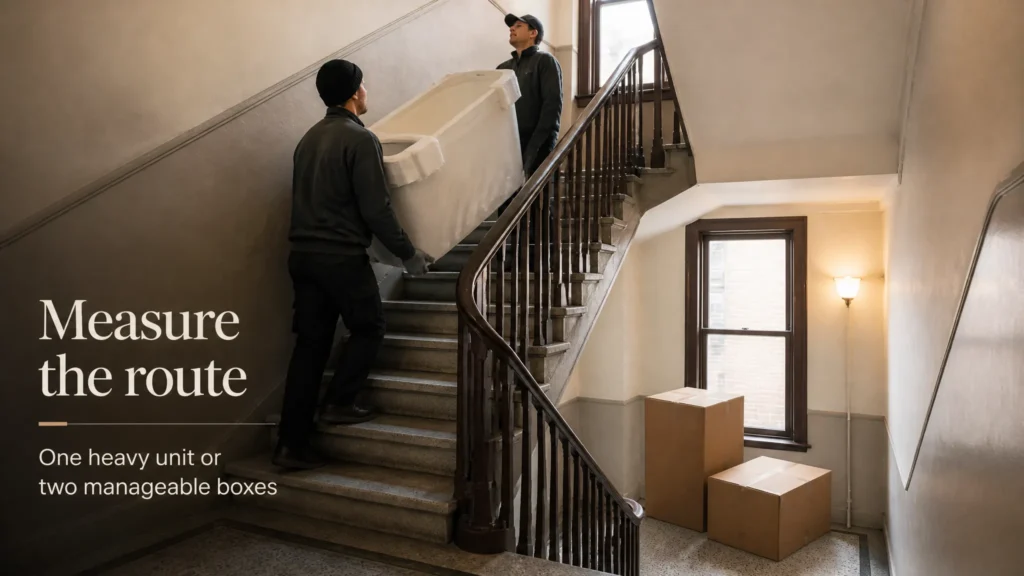
Measure your doorway, your hallway corners, and your staircase before you order. Please, actually do this.
A one-piece smart toilet often weighs 40 to 60 kilograms. It’s dense, awkward to grip, and surprisingly easy to chip. Getting one up an older apartment staircase takes two people at minimum, sometimes three, and a cracked body halfway up the stairs is the kind of expense that ruins a week.
The two-piece arrives as a bowl and a tank. Each piece is lighter and easier to pivot around tight corners, which matters enormously in walk-up apartments, or when a landlord is arranging deliveries without a full crew.
Which Fits Your Bathroom?
Choose one-piece if…
- You’re renovating. The floors are already torn up and delivery is easy at that stage. The seamless look will hold up for a decade.
- You can’t stand that seam. People who upgrade for cleaning rarely go back, in our experience.
- It’s the main bathroom. This is the design that feels expensive in person, not just in photos.
- The room is small. The lower tank frees up visual space.
- It’s for a hotel or a show apartment. The bathroom has to impress without you in the room to explain it.
Choose two-piece if…
- Price is the deciding factor. You lose nothing on features. Spend the difference on a better seat if you want.
- You want repairs to stay boring. Standard parts, any plumber, no waiting on a factory.
- There are stairs involved. Two lighter boxes beat one heavy slab.
- You’re a landlord. Plumbers know these inside out, service is cheap, and replacing one after a bad tenant doesn’t hurt as much.
- You’re swapping an old toilet in place. No renovation needed. This is the least disruptive upgrade there is.
Three Quick Checks Before You Order
- Rough-in. Wall to drain bolts is usually 12 inches, but older homes vary. Both designs need the right rough-in to sit flush against the wall.
- The route, not just the room. Doorways, stair turns, elevator depth. For a one-piece, arrange two carriers and some corner padding.
- The outlet. Both need a GFCI outlet within reach of the base. No outlet nearby? Add an electrician to the budget now rather than on installation day.
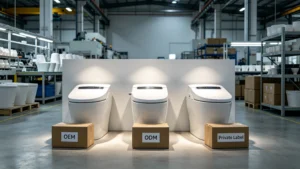
The same thinking applies at scale. Hotels and apartment projects tend to put one-piece models in the rooms that need to impress, and two-piece models everywhere budget and maintenance logistics dominate. If that’s your world, talk to us at Bikibath before you lock in a design. Mixing both across a building is often the smarter split, and we’ll quote each option straight.
FAQ
Is a one-piece toilet always better than a two-piece?
No. It’s better on looks and cleaning, worse on price, repairs and handling. Which of those matters more depends on your bathroom, not on the product category.
Can a two-piece toilet leak between the tank and bowl?
Over many years, yes. The gasket between the two parts can degrade and weep. It’s a cheap, well-understood fix. A one-piece eliminates the possibility entirely because there’s no joint to fail.
Which design lasts longer?
The ceramic bodies on both designs can last decades. What differs is the service path. Two-piece tanks use universal parts, while a one-piece depends on the manufacturer keeping spares available. Buy from a company that commits to parts supply and the gap mostly disappears.
Are there smart features only available on one-piece models?
A few. Fully integrated auto open/close lids and hidden-tank designs are usually built on one-piece platforms. The core features, meaning warm wash, heated seat, dryer and auto flush, exist on both.
Is a one-piece harder to install?
Not harder, just heavier. The plumbing connections are the same. The hard part is muscle, not skill.
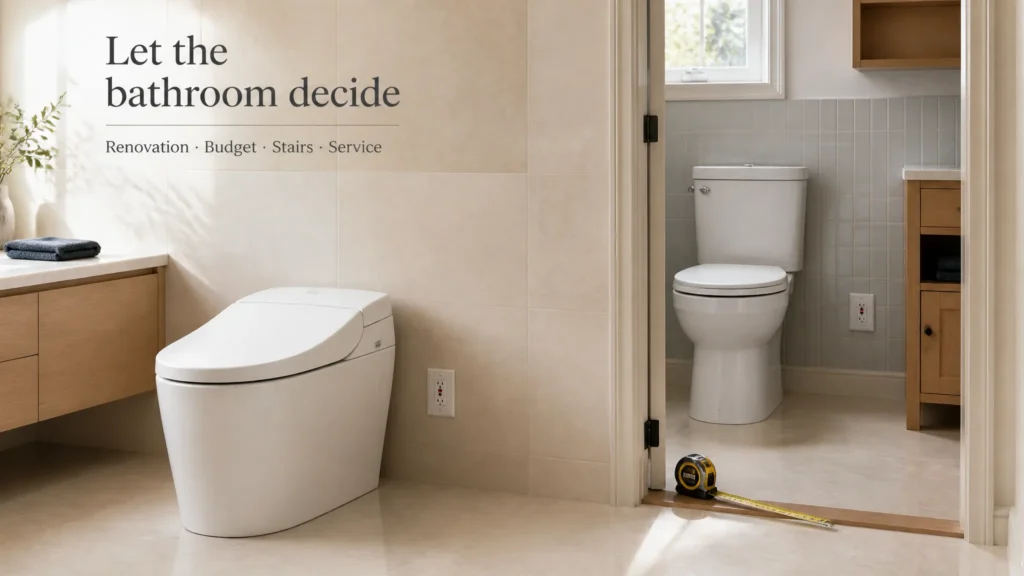
Let Your Budget and Bathroom Decide
Renovating anyway? Stretch for the one-piece. The cleaner look and the easier cleaning are the two things you’ll appreciate every single day.
Upgrading in place, watching the budget, dealing with stairs? The two-piece gets you the auto wash, the heated seat, all of it, on a body that costs less to buy and less to fix.
Either way, you can browse both designs in our smart toilet catalogue, or contact us for help with sizing and quotes.

 English
 Português do Brasil
 Español de México
 Deutsch
 Français