
If you’ve been shopping for a smarter bathroom, you’ve probably hit the same wall. Half the results talk about “smart toilets.” The other half talk about “bidet toilet seats.” And nothing makes it clear whether those are the same thing or two different products.
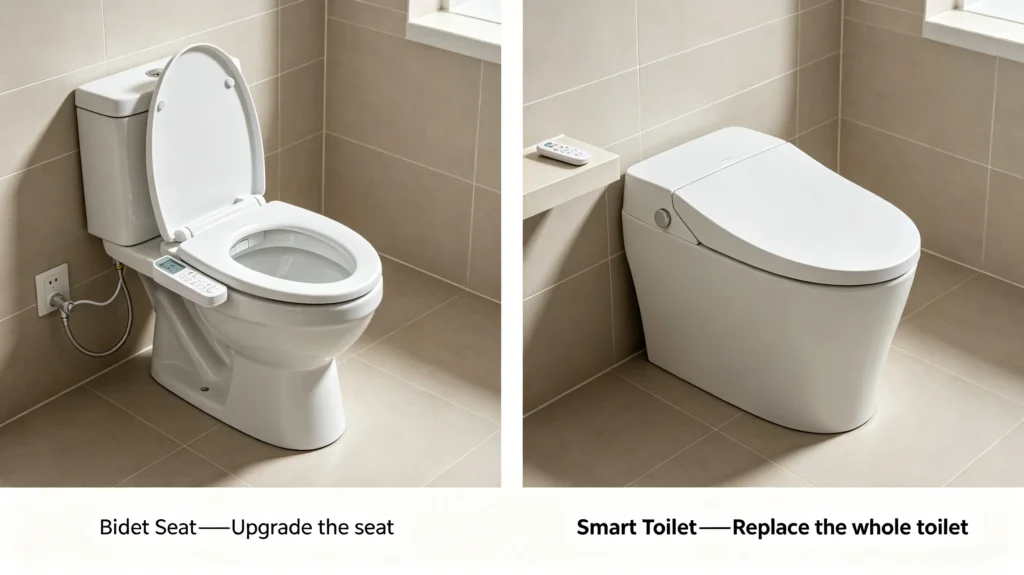
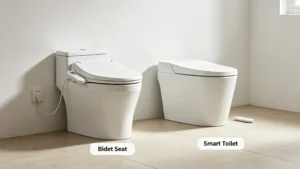
Here’s the short version: they’re related, but they’re not the same. A bidet seat bolts onto the toilet you already own. A smart toilet replaces the whole thing.
That one difference explains almost everything else — features, price, installation, and who should buy which. Let’s break it down so you can make the call in about five minutes.
What Is a Bidet Seat?
A bidet seat — also called a washlet, an electronic bidet, or a smart toilet seat — replaces your regular seat and lid. It connects to the water supply and, on most models, plugs into a wall outlet.
Once it’s installed, you get:
- Warm water washing — front and rear, with adjustable pressure and temperature
- A heated seat that you can dial up or down
- A warm air dryer
- Extras on better models — deodorizer, self-cleaning nozzle, night light
The key point: your bowl and tank stay exactly where they are. You’re upgrading the seat, not the toilet.
What Is a Smart Toilet?
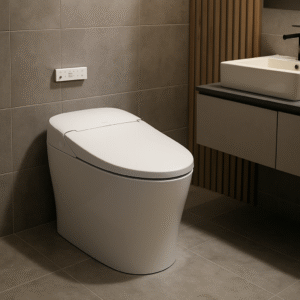
A smart toilet is a complete unit. Bowl, tank (or tankless body), seat, and electronics are all designed and built together. Nothing attaches to an existing toilet, because the toilet itself is the product.
On top of the washing and drying you’d get from a good bidet seat, most smart toilets also add:
- Automatic open and close lids
- Motion-activated or foot-pedal flushing
- Rimless, tornado, or siphon jet flush designs
- Built-in water heating that doesn’t depend on your home’s hot water supply
- Self-cleaning cycles and easier-to-wipe surfaces
Because the whole thing is engineered as one product, a smart toilet usually looks cleaner and more streamlined than a standard toilet with an electronic seat bolted on top.
Smart Toilet vs. Bidet Seat: The Main Differences
| What matters | Bidet seat | Smart toilet |
|---|---|---|
| What you replace | Just the seat and lid | The entire toilet |
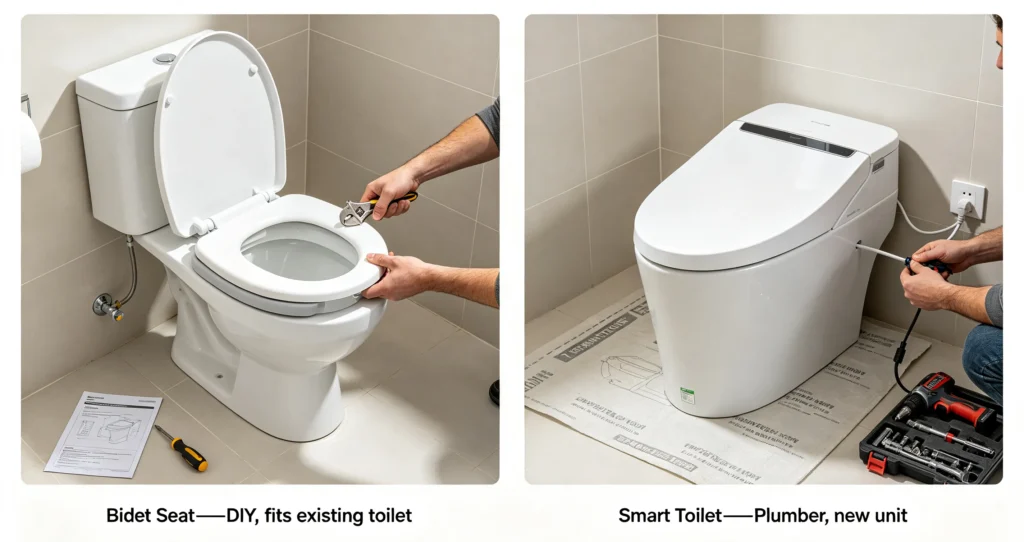
| Installation | DIY-friendly for most people | Usually needs a plumber |
| Fits your existing toilet | Yes | No — it is the toilet |
| Look | Standard toilet, upgraded seat | Seamless, one-piece design |
| Water heating | Plug-in electric | Integrated (tank or instant) |
| Upfront cost | Lower | Higher |
| Flush quality | Unchanged | Better, integrated flush systems |
| Cleaning | Same as before | Often self-cleaning, easier to wipe down |
| Best for | Renters, tight budgets, quick upgrades | Renovations, better flush, unified look |
How to read that table: a bidet seat upgrades your comfort. A smart toilet upgrades your comfort and your toilet.
Where the price gap actually goes
The seat’s cost is mostly electronics — a small heater, a pump, a control board, and the molded seat itself.
A smart toilet adds a ceramic body built to your chosen design, an integrated flush system, concealed plumbing, and a stronger water-heating module. That’s why the gap is measured in hundreds, not tens — and why the extra money buys durability and flushing performance, not just comfort features.
Which Should You Choose? Match It to Your Situation
There’s no universal “better” option here. It comes down to what you have now, and what you’re trying to fix.
Choose a bidet seat if…
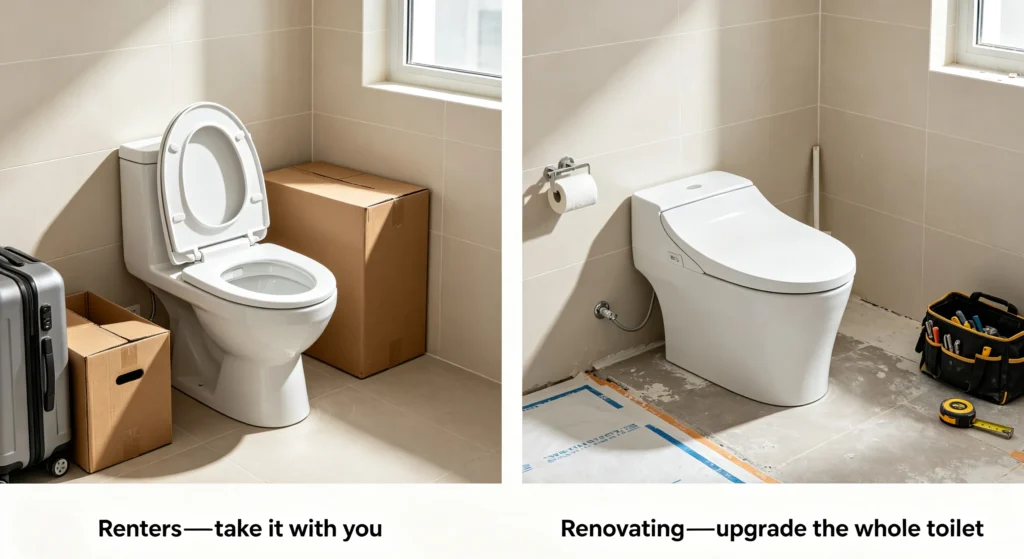
- You rent. A bidet seat moves with you when you leave. A smart toilet stays behind.
- Your toilet still works well. If the bowl and flush are fine, replacing the whole thing is wasted money.
- You’re watching the budget. A good seat covers the essentials — warm wash, heated seat, dryer — for a fraction of the price.
- You want it handled today. Most seats install in under an hour with basic tools.
- You’re not sure yet. A seat is the low-commitment way to test the habit before committing to a full smart toilet.
Choose a smart toilet if…
- You’re renovating anyway. When the bathroom is already torn apart, the extra cost becomes a much smaller decision.
- You want a better flush. No seat can fix a weak, noisy, or clog-prone toilet. A smart toilet replaces the problem instead of working around it.
- You’re tired of scrubbing. Rimless bowls and automatic flush cycles genuinely cut down cleaning time.
- You want the clean look. A one-piece smart toilet looks dramatically better than a standard toilet wearing an electronic seat.
- It’s a rental or guest bathroom. Motion lids, auto-flush, and touchless controls matter far more in shared spaces — more on that below.
The Four Questions That Actually Decide It
Skip the spec sheets. Answer these instead:
- Do you own or rent? Owners can install either. Renters should almost always choose a bidet seat.
- How old is your toilet? Under ten years old and flushing well? A seat makes sense. Older and troublesome? A smart toilet fixes two problems at once.
- What’s your power situation? Both need a nearby outlet. Instant-heating smart toilets may need a dedicated circuit — worth checking before you commit.
- Who will be using it? For most households, a seat covers everyone comfortably. For older family members or anyone with mobility issues, a smart toilet’s auto lid and auto flush remove real physical steps.
Common Misconceptions
“A bidet seat is basically the same as a smart toilet.” The washing features overlap, but a seat can’t improve your flush, your bowl cleaning, or the look of the bathroom. It’s an upgrade to your seat, not your toilet.
“Smart toilets stop working when the power goes out.” Most keep a manual flush, so you’re never locked out of a functioning toilet. Washing and heating need power, obviously.
“Bidet seats are hard to install.” Most fit standard two-bolt toilets and take under an hour. Check compatibility first if your toilet is very old or an unusual shape.
“Smart toilets are only for luxury homes.” Affordable models now cover the essentials, and the gap between a “regular toilet plus quality bidet seat” combo and an entry-level smart toilet is smaller than most people expect.
If You’re Buying for a Project or Business
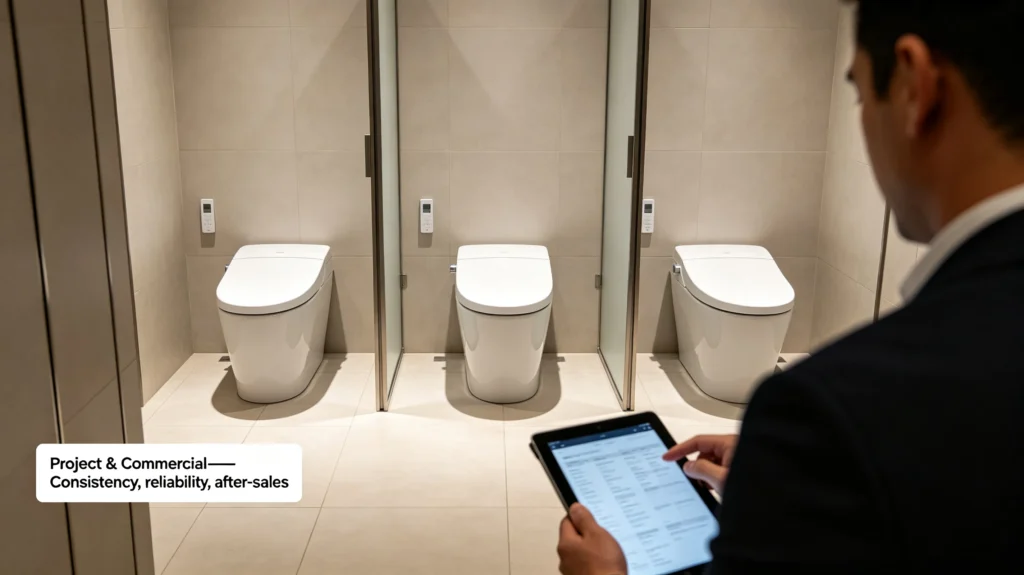
The decision logic shifts when you’re sourcing for a hotel, an apartment development, or resale.
Here, reliability, uniformity, and after-sales support matter more than any single feature. For commercial use, a full smart toilet usually beats mixing standard toilets with bidet seats: fewer SKUs, one consistent installation standard, and a far stronger impression in guest bathrooms.
Budget-driven projects sometimes compromise — standard bowls throughout, with premium seats in a few key rooms. It works, but guests notice the difference, and maintenance ends up split across two product lines.
If that’s your situation, talk to a manufacturer directly rather than shopping consumer listings. You’ll get straight answers about what holds up under daily commercial use and what doesn’t. That’s the conversation we have every day at Bikibath — send us your project details and we’ll tell you honestly what fits.
FAQ
Is a bidet seat the same as a smart toilet seat?
Yes — the terms are used interchangeably. It’s an electronic seat that replaces your standard one and adds washing, heating, and comfort features.
Can you put a bidet seat on any toilet?
Most standard toilets, yes. Round and elongated seats come in different sizes, and very old or non-standard models may not fit. Check the seat’s compatibility notes and measure your toilet first.
Do I need a plumber for either one?
For a bidet seat, usually not — most installations are DIY. For a smart toilet, plan on a plumber, since it replaces the toilet itself and may involve a new water line or power connection.
Which uses more electricity?
Both draw the most power when heating water. Instant-heating models pull more at peak moments; tank-style models keep a small reservoir warm. The difference in monthly running cost is usually small either way.
Does a smart toilet save water?
Generally, yes. Modern smart toilets use efficient flush systems — often dual-flush or high-pressure designs — that use less water per flush than older standard toilets. Over a household’s lifetime, that adds up.
Let Your Current Toilet Decide
If your toilet is in good shape, get a bidet seat. If you’re renovating, want a better flush, or want the cleanest possible setup, get a smart toilet.
Still torn? Start where your bathroom is today. A bidet seat gets you most of the experience for a fraction of the investment — and you can always upgrade the toilet itself later.
 English
 Português do Brasil
 Español de México
 Deutsch
 Français